 |
   |
|
|
 |
Liebherr Cranes Elevate Climate Science Above the Amazon Rainforest Canopy
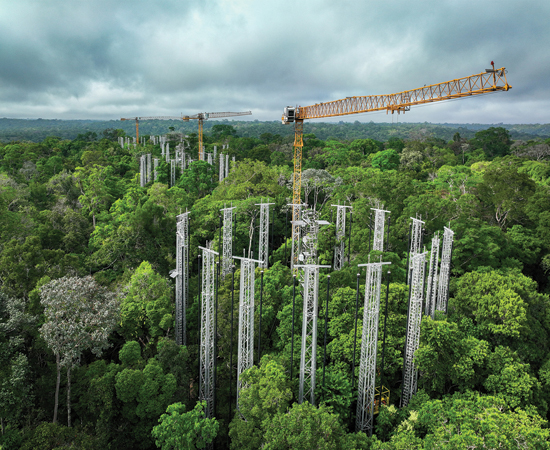
At the AmazonFACE experimental site near Manaus, Brazil, the boundary between construction technology and climate science has effectively dissolved. The 4 Liebherr cranes installed here are not building anything. They are the primary means of access for a international team of researchers conducting what may be the most consequential ecological field experiment currently underway anywhere on the planet. The AmazonFACE programme – the largest scientific partnership between Brazil and the UK – was created by the Ministry of Science, Technology and Innovation. Led by Brazil's National Institute for Amazonian Research (INPA) in collaboration with the University of Campinas (Unicamp), AmazonFACE (Free-Air Carbon Dioxide Enrichment) exposes an intact section of old-growth Amazon rainforest to CO2 levels projected for the coming decades. The programme operates within a living, functioning ecosystem that plays a decisive role in the global carbon cycle. Using the method developed by the AmazonFACE team of over 150 specialists in collaboration with the UK Met Office and other partners, researchers can observe in real time how the forest canopy, soil, biodiversity and carbon uptake dynamics respond to future global atmospheric conditions. Researchers from the United Kingdom, Germany, Austria, the Netherlands and the U.S. are active members of the scientific committee. The programme explicitly targets outputs that will inform both regional Amazonian policy and international climate frameworks, including the commitments discussed at COP30, which took place in Belém, Brazil, in November 2025. The Amazon basin stores an estimated 150 to 200 billion t of carbon in its vegetation and soil. Whether that carbon store grows, remains stable or diminishes under rising CO2 concentrations is one of the central unresolved questions in Earth system science – and the answer will substantially shape projections for global warming trajectories. The decision to deploy tower cranes at AmazonFACE rather than scaffolding structures, elevated walkways or other access platforms was made explicitly on grounds of environmental preservation. A tower crane's mast occupies an exceptionally small area of ground – a critical consideration when working within an old-growth forest where soil disturbance, root system damage and canopy opening must be kept to an absolute minimum. At the same time, the crane's horizontal reach means a single unit can cover a wide area of experimental plot without requiring repositioning, eliminating the repeated ground disturbance that any alternative access solution would entail. By providing a reliable, safe and environmentally responsible platform for canopy-level research, the Liebherr 85 EC-B tower cranes are enabling scientific work that would otherwise be impossible at this scale.
|
|
|||
© InfraStructures - Tous droits réservés - All rights reserved |
 Partagez sur Facebook / Share on Facebook


