 |
   |
|
|
Keeping Welding Fume Away
Expert welders are more in demand than ever before – and yet the profession remains unattractive to many. One of the reasons for this hesitance is welding fume. But how justified is this fear? And how can the risk be effectively controlled? A look behind the scenes shows that understanding the different factors at play and taking the right measures in response can reliably minimize welding fume and allow welders to work safely. During arc welding, the arc itself reaches temperatures of several thousand degrees. Metal vaporizes, reacts, and condenses to produce welding fume. It is made up of both gaseous elements (such as ozone, carbon monoxide, carbon dioxide, or nitrogen oxides) and particulates, like iron, nickel, and lead oxides, manganese, or chromium compounds. Yet around 95% of the emissions come from just one source: the filler metal (i.e., the wire that is continuously fed into the weld pool).
Of course there are regulatory standards that have to be observed. In Austria, a distinction is made between MAK values (maximum workplace concentration) and TRK values (technical reference concentration). While MAK values are considered harmless when adhered to, TRK values do not guarantee any freedom from risk. They are a technical standard value, often for substances whose harmlessness is not assured, such as chromium compounds. The standard value here is 0.02 mg/m3.
Effectively reducing welding fume follows a clear hierarchy: the STOP principle. Substitution and technical solutions act as collective protection and thus also protect people in the vicinity – these are therefore the measures that should be prioritized. If this is not possible, companies should adopt organizational measures that mainly limit residual exposure. The final measure is personal protective equipment (PPE). As PPE only protects an individual, it is considered the lowest rung of the STOP hierarchy.
A study conducted by a German research and joining technology association (FEF) together with Fronius demonstrated just how important the correct welding machine settings are in reducing welding fume emissions. In addition to the process itself, the parameters have a significant impact on the fume emission rate (FER). In a comparison of 3 different process variants (standard, low spatter control (LSC), and pulsed arc), the pulsed arc proved to be the process that produced the most stable material transfer and the lowest emission rate. Process parameters such as wire speed, voltage, and amperage were the same in each case. Welding was carried out with a G-3Si1 wire (Ø 1.2 mm) on hot-rolled unalloyed structural steel (S235JR) with the shielding gas M21 (82% Ar/18% CO2), fully mechanized and under reproducible conditions. What the measurements revealed However, it was the arc length correction that had the greatest impact. Even a moderate increase in the average voltage (by around +0.4 V) significantly reduced the FER at all wire speeds. As an optimal arc length minimizes short-circuit phenomena, a smoother material transfer can be ensured – resulting in less metal vapor and fume. Fillet welds: here, emissions were lower overall, but showed the same behavior. Here, too, the pull technique proved to be advantageous when welding with a fume extraction torch, especially at high wire speeds. A detailed test at 11 m/min resulted in an FER minimum at a correction of -1.5 V. If the arc was extended or shortened, the emissions increased again – either due to a higher process power or an increased number of short circuits. Rules for the workshop Optimize the wire speed: A wire speed of 5 m/min produced the lowest emission values under test conditions. As a rule of thumb, a lower arc power reduces emissions even if the welding process remains the same. Capture fumes before they spread Wherever a fume extraction torch cannot be used (such as during MMA welding), an extraction system is an effective alternative. Not only does its flow-optimized and rotatable extraction hood cover a large area, but its large filter area and mobility make it ideal for frequently changing workplaces. All Exento systems meet the requirements of DIN EN ISO?21904-1 for capturing and separating welding fume. This standard specifies the general requirements for local fume capture and extraction equipment, including the design of hoods, ducting, filter units, airflow rate systems, warning systems, and safety-related workplace instructions. Its purpose is to ensure that welding fume is captured as completely and as closely to the point of origin as possible and reliably separated. Personal protective equipment is used to protect individual welders when area-based extraction systems reach their limits. Powered air purifying respirators (PAPR) reliably protect against the finest welding fume particles by continuously forcing filtered, clean air into the helmet. The combination of positive pressure in the helmet and highly effective particle filters significantly reduces the level of pollutants, especially when working in confined spaces, hard-to-reach areas, or with processes lacking direct extraction at source. Modern welding helmets with a fan filter unit are a perfect example of effective PPE. A uniform air flow, reduced heat load, and an unobstructed field of vision support precise work even during long shifts. Welding fume exposure is not inevitable |
|
|||
© InfraStructures - Tous droits réservés - All rights reserved |
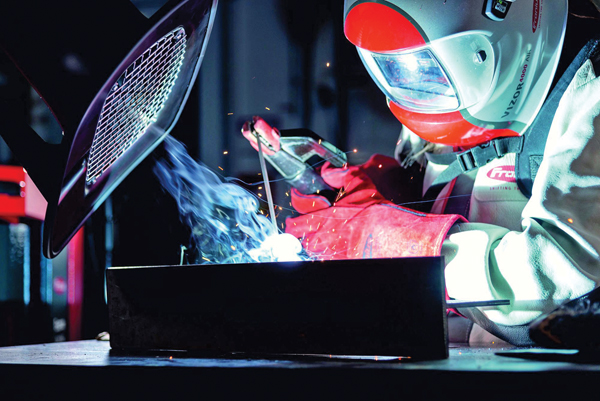
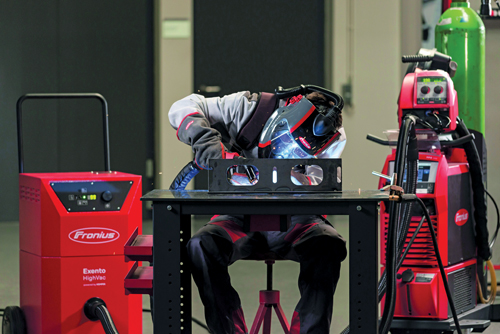 Welding fume is largely a hidden danger. As the majority of the particles are ultra-fine (often smaller than 1 µm, some even less than 0.1 µm), they are easily inhaled. Certain particles can even reach the alveoli – the air sacs in the lungs where oxygen and carbon dioxide is exchanged with the blood. From there, they can (depending on their composition) penetrate into the bloodstream. The consequences can be severe, ranging from chronic respiratory problems (e.g., siderosis with iron oxides) to toxic effects caused by exposure to carbon monoxide, nitrogen oxides, ozone, or manganese oxides. Chromium compounds and nickel oxide even represent a carcinogenic risk, especially when welding high-alloy steels.
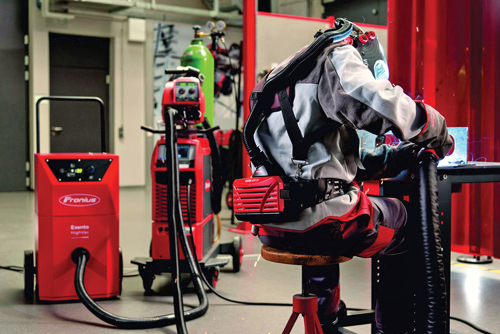 Different countries enforce different emission values. The Netherlands is particularly strict with a respirable fraction of 1 mg/m3, Germany stipulates 1.25 mg/m3, while a value of 5 mg/m3 ambient air applies in Austria (as well as France, Belgium, Norway, U.S., and Canada). However, it is important to note that limit values, standards, and regulations are just a snapshot of the situation at a given moment and can change at any time. Companies should regularly check the current national requirements and adapt their risk assessments accordingly.
 Partagez sur Facebook / Share on Facebook


