 |
   |
|
|
Electric Trucks Also Drive Efficiently in Winter
Of the around 6,500 km covered through Northern Europe, over half of the tour took place on identical routes to the northern part of the almost 7-week European Testing Tour that took place in summer 2024. Once again, the 2 trucks were on the road with a gross combination mass of 40 t. “Not only are we interested in how the energy consumption of the eActros 600 behaves in different winter operations, but above all our customers and drivers. We are very satisfied with the findings of the tour. They show us that the eActros 600 can also be very efficient and comfortable on the road in European winter,” declared Christof Weber, head of Global Testing Mercedes-Benz Trucks. The 16-day tour set off northwards in mid-January from Wörth am Rhein. The route first went through Germany, Denmark, Sweden, and Finland to the Arctic Circle. It then went back to Stuttgart and Wörth via Estonia, Latvia, Lithuania, Poland, the Czech Republic, and Austria. On their journey through 10 countries in Northern Europe, the electric trucks were on the road at temperatures between -18°C and 9°C. The daily average speeds ranged from 64 to 77 km/h. “Ultimately, aerodynamics and rolling resistance have a considerable influence on the consumption of a truck – regardless of the drive type. The higher air density at lower temperatures in winter always leads to increased air resistance – and thus to increased consumption. The tires required for driving in winter also have greater rolling resistance and increase consumption – the wintrier the road conditions, the better the tires’ grip needs to be and the higher the consumption,” explained Jochen Gottstein, manager Testing Energy Consumption & Range at Daimler Truck, who was present for the entire tour. Pleasant temperatures when driving, living, and sleeping in the driver’s cab have little influence on the range. This means that drivers do not have to freeze in the eActros 600 or scrimp on heating, even in winter. For example, the engineers covered almost 3,000 km in the first 5 days and spent day and night in their trucks. “During the day, we set the temperature to 21°C and at night to 19°C for sleeping – at outside temperatures between -7°C and 4°C,” explained Werner Kempfle, development engineer and co-project manager of the eActros 600, who was also on the tour. “This only led to a reduction in range of 2 to 5%. With regard to total consumption, the so-called “hoteling” share is therefore hardly significant, and even with a battery-electric eActros 600, you don’t have to worry about not being able to reach your destination as a result of heating the cab.” As in the summer, the electric trucks were charged exclusively at public charging stations in the winter. “Although it is still challenging to find charging options specifically designed for trucks, we found some state-of-the-art charging parks in Scandinavia in particular, where we did not have to unhitch our trailers and where there was sufficient charging capacity and good infrastructure for driving breaks,” said Jochen Gottstein.
“Ultimately, however, we also have to admit that this was rather the exception, and that charging infrastructure still needs to be expanded in most of the cases we have seen,” he continued. The newly introduced “Mercedes-Benz Trucks Remote 3.0” app for the eActros 600 has also made life much easier for drivers. The mobile app is a digital interface between the driver and the truck that can be used to call up important status information, such as the battery status and state of charge, or to receive push notifications. “Especially when charging, the app has proven to be extremely helpful. It meant that we drivers didn’t have to stay permanently with the vehicle during the charging time. Thanks to the app, we had the vehicles under control at all times, could see the state of charge and were able to react immediately in the event of a charging interruption, for example,” said Werner Kempfle. The eActros 600 has 3 battery packs, each with 207 kWh nominal capacity. These offer an installed total capacity of 621 kWh. The batteries are based on lithium iron phosphate cell technology (LFP) and are characterized by a long service life. The development engineers at Mercedes-Benz Trucks have designed the eActros 600 to meet the same requirements on the durability of the vehicle and components as a comparable conventional heavy-duty long-haul Actros. That means up to 1.2 million km in 10 years of operation. After this period of use, the battery state of health should still be over 80%. In contrast to other battery cell technologies, more than 95% of the installed capacity can also be used with LFP technology. This makes a higher range with the same installed battery capacity possible. The vehicle is technically designed for a gross combination mass of up to 44 t. With a standard semitrailer, the eActros 600 has a payload of around 22 t in the EU. In some cases, national law may permit a higher payload. Daimler Truck celebrated the start of series production of the eActros 600 at the end of November last year at the Mercedes-Benz plant in Wörth. The eActros 600 has been delivered to customers since December 2024. In addition, the e-truck was voted “International Truck of the Year 2025”. The award is the most important prize in the industry and is presented annually by the International Truck of the Year (IToY) organisation, consisting of 24 commercial vehicle journalists from Europe.
|
|
|||
© InfraStructures - Tous droits réservés - All rights reserved |
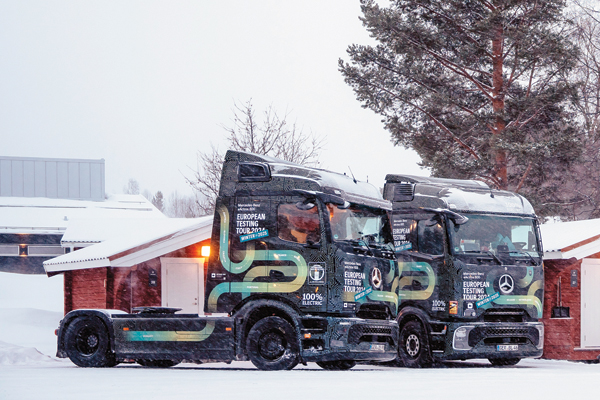
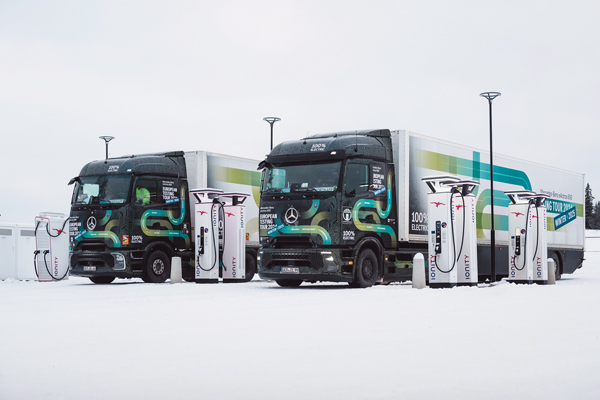 On particularly demanding routes with predominantly snow-covered and partially icy roads, the increased energy consumption rose to almost 50% compared to driving in summer on efficiency class A tires. This is primarily due to the significantly increased motion resistance. The drive-independent rolling resistance of the energy efficiency class D Scandinavian tires designed for these extreme winter conditions played a significant role in this.
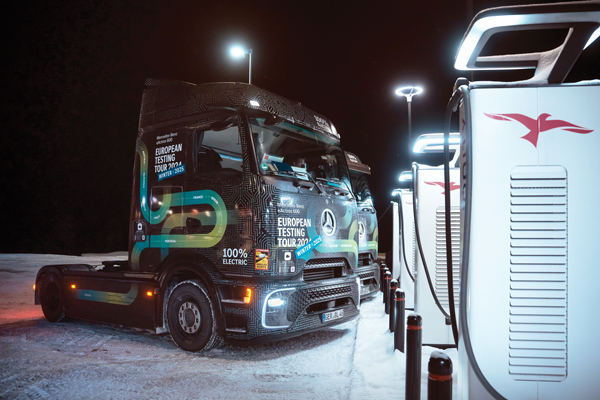 Especially in winter, in very cold temperatures and snow, this is a great relief for the drivers.
 Partagez sur Facebook / Share on Facebook


