 |
   |
|
|
Robots Are Reshaping Pipe Machining
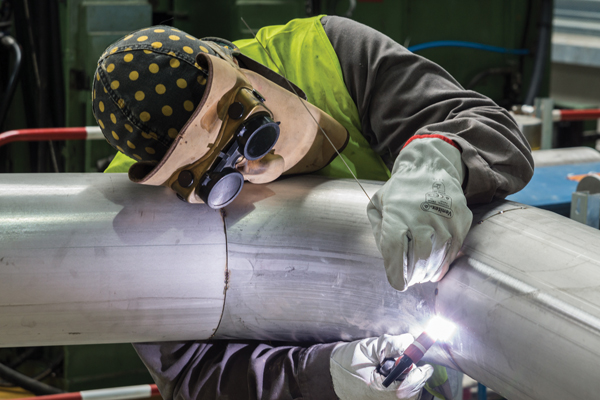
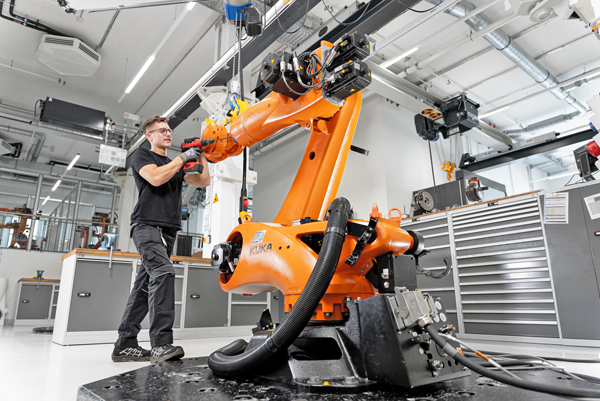
Robots deliver consistently precise results. And unlike their human counterparts, they do not even bat an eyelid. Because robots “work” efficiently, reducing costs and improving sustainability, they are being used increasingly across the pipe and metal industries. Companies in these sectors see further automating their processes as a worthwhile investment. Pipe manufacturers and processors are supported by partners supplying the innovative production equipment they need. Pipes and robots are simply a perfect match. Both areas are growing and complement each other: Data Bridge Market Research expects the European pipe market to grow by around 5% annually between 2023 and 2030. By 2030, the market could reach a value of almost US$34 billion ($47 billion). This growth is driven in particular by developments in the European energy landscape and the increasing importance of pipelines. According to Data Bridge Market Research, the German pipe market is the fastest-growing in Europe. Robot Adoption Has Doubled The OECD and IMF forecast growth of between 2.9% and 3.1% for the global robotics market in 2026. Asia dominated the market in 2024, with 74% of new installations, compared with 16% in Europe and 9% in the Americas. Worldwide, 4.664 million industrial robots were in operation in 2024, a year-on-year increase of 9% according to the IFR. China remains by far the largest market, accounting for 54% of all installations. Germany is Europe’s largest and the world’s 5th-largest market for robotics. Although installations fell by 5% in 2024 to 26,982 units, this still marks the second-best result, second only to the record year of 2023. Digitalisation plays a key role in the use of robots: for example, a central KUKA software platform covers the entire automation process and enables seamless data exchange across all planning and production steps. “Using robots has become easier and faster than ever before thanks to digital twins,” the company notes. Offline programming and virtual commissioning further support automation solutions within Industry 4.0 environments. Fully Integrated Industrial Robots “Thanks to this complete integration of the industrial robot into the production process, the EasyRobot significantly reduces the programming time for bending programmes involving handling tasks, and reduces costs associated with specialist operator training.” In many WAFIOS CNC machines for producing springs, wire and bent-pipe components, the robot can now be directly controlled by the machine interface, allowing the component and robot programmes for the spring or the bent part to merge seamlessly. As WAFIOS notes, the time-consuming set-up of the robot in a separate step, along with the need for specialised programming skills and training, is no longer required. Leveraging AI in Industrial Manufacturing AI-driven manufacturing is also at the heart of the collaboration between Maincor Rohrsysteme, Maxsyma, and the Fraunhofer Institute for Production Technology and Automation (IPA). This project is focused on optimising production processes and improving maintenance and quality assurance. As Maincor explains, “Precise monitoring and predictive maintenance are key to increasing efficiency and quality.” The central pillar of the project is an intelligent algorithm designed specifically to monitor ultrasonic welding, capable of detecting faulty welds immediately and significantly reducing scrap and machine downtime. A Strong Outlook for the Industry The world’s most important trade fair for the wire and cable industry will take place in Düsseldorf. Explore trends and highlights from across the wire, cable and tube industries at the wire & Tube Expo. The next edition will be held in Düsseldorf, from April 13-17, 2028 in Düsseldorf. |
|
|||
© InfraStructures - Tous droits réservés - All rights reserved |
 Improving Efficiency, Enhancing Sustainability
 Partagez sur Facebook / Share on Facebook


